From Symptoms
to Source
Discovery Through Observation

Role
Experience Design Consultant
Tasks
Requirements Gathering, User Research, Analysis
Background
Notes
Sky advisors log short notes during or after customer calls. These notes capture key information such as customer intent, actions taken, and any products or services discussed, upgraded, or downgraded.
The notes are saved to the customer’s account and are intended to help subsequent advisors quickly understand previous interactions and continue the conversation seamlessly.
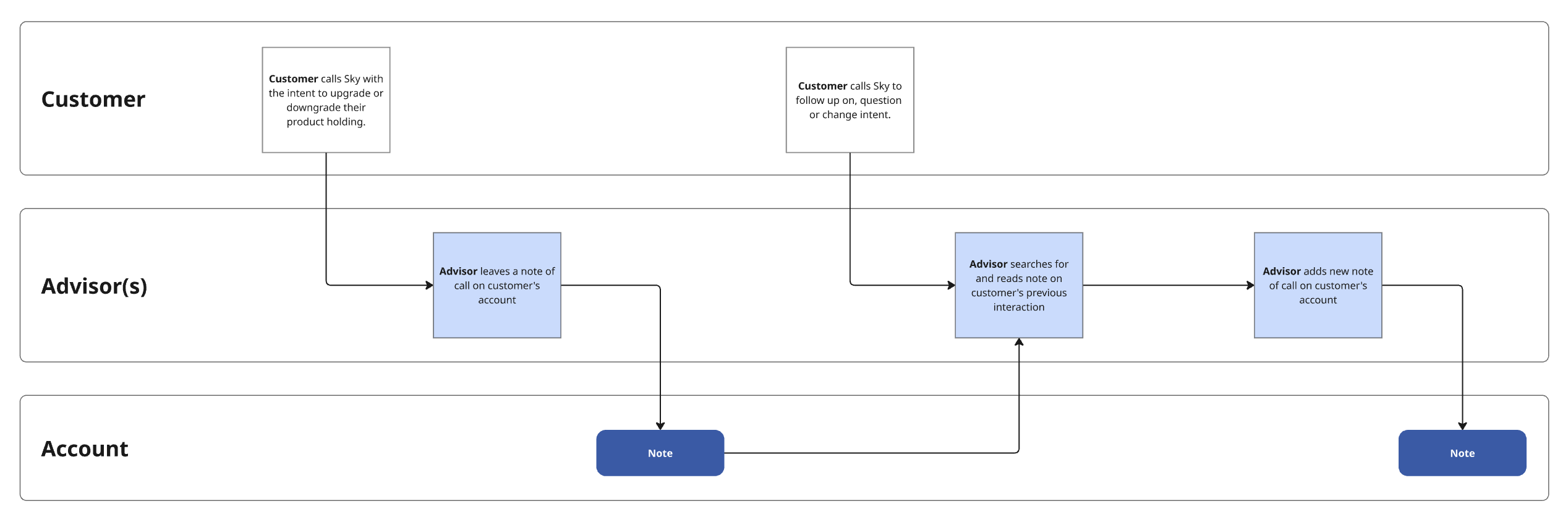 As-is process diagram of interaction between customer, advisor(s) and system (account).
The problem
Creating interaction notes increased Average Handling Time (AHT). Additionally, when subsequent advisors reviewed these notes, inconsistencies and inaccuracies often required clarification, further extending handling time.
This cumulative increase in AHT reduced advisor productivity, increased operational costs, and negatively affected both advisor and customer experiences.
Research
Ethnographic research (Call Centres)
While observing advisors as they wrote notes during live customer calls, a concerning pattern emerged.
Advisors were retrieving product and service prices from memory, laminated reference sheets, or whiteboards. They then calculated monthly costs manually using mental math, calculators, or mobile apps.
These figures were written into the customer notes and saved in the system.
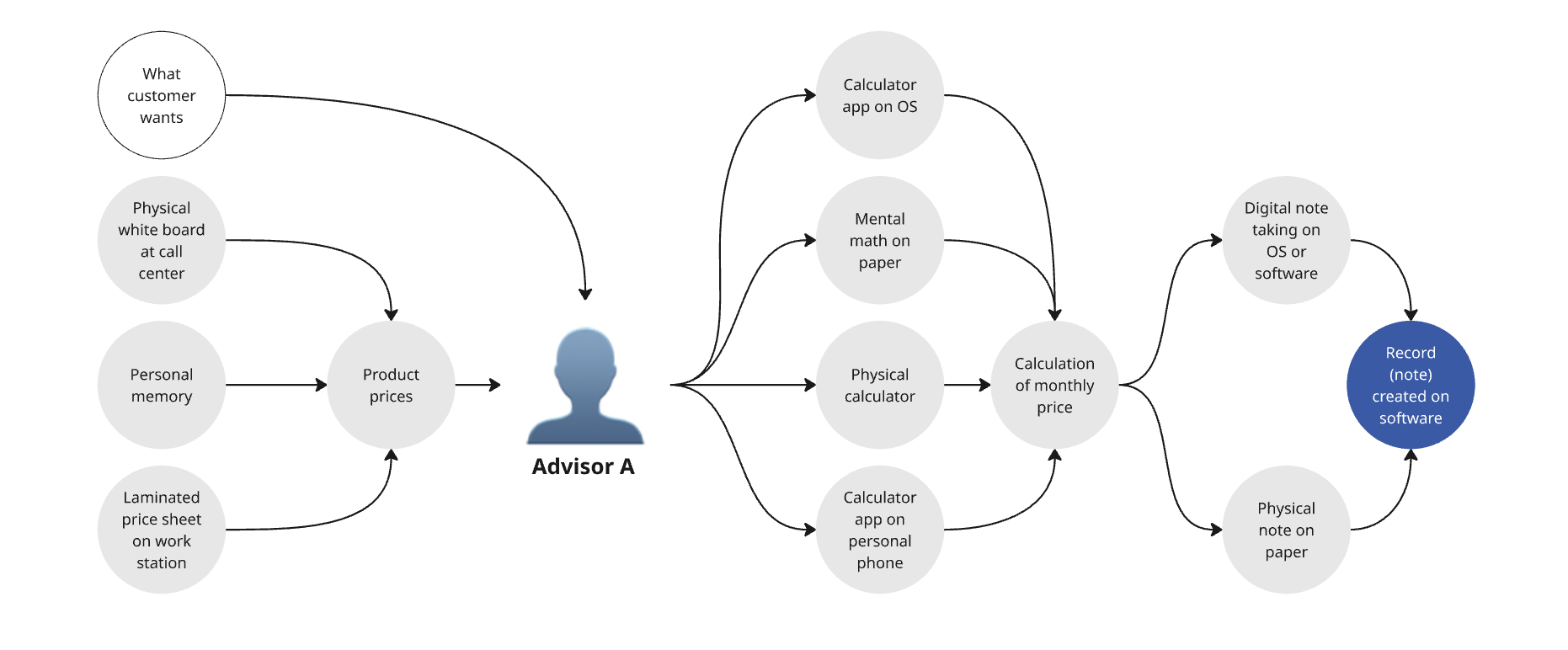 Flow of advisor creating a note.
Call center software already provided product and service pricing, and automatically calculated one-off payments and monthly costs.
Despite this, advisors were actively bypassing these tools, preferring to calculate costs manually, which increased AHT and cognitive load, and created notes that were potentially exposed to human error.
Why?
User Interviews
To understand this behaviour, I conducted interviews with advisors focused on how they read and write notes, and why they chose manual calculations over system-provided tools.
Our users needed...
- Confidence they were communicating correct prices to customers.
- Accurate and up-to-date product, offer, and service pricing.
- A reliable system to calculate totals and monthly cost.
- Accurate, consistent, and trustworthy notes regarding a customer's previous interactions.
Our users struggled with...
- Incorrect pricing displayed on the software.
- Incorrect total and monthly calculations generated by the system.
- Inconsistent and unclear notes left by other advisors.
Insight
The rise in AHT was not simply a documentation problem. At its root, a system defect was eroding user trust. When the system failed to consistently provide correct pricing and calculations, advisors stopped relying on it altogether. This behaviour was rational, but costly.
Although this was not the only factor causing the friction observed, it was critical and required urgent attention.
Actions
- Alerted the UX team to the pricing and calculation inaccuracies.
- Flagged other relevant issues to the CRF team.
- Partnered with advisors to capture screenshots of incorrect prices and totals.
- Combined observational research and advisor evidence into a clear narrative.
- Presented findings to the UX team, product management and key stakeholders.
Outcomes
This research directly led to a new project focused on overhauling how costs are calculated and displayed to advisors, grounded in user needs and trust restoration.
Takeaways
- Observation is fundamental to discovery. The root issues only surfaced through watching users in real contexts.
- Trust is built through consistency. When a system repeatedly fails to meet expectations, users will work around it.
- Symptoms are not the problem. Addressing surface-level inefficiencies without fixing the underlying cause leads only to partial mitigation.
- Manual documentation introduces inconsistency and human error. Automation can reduce this — but only when the system is reliable enough to be trusted.